
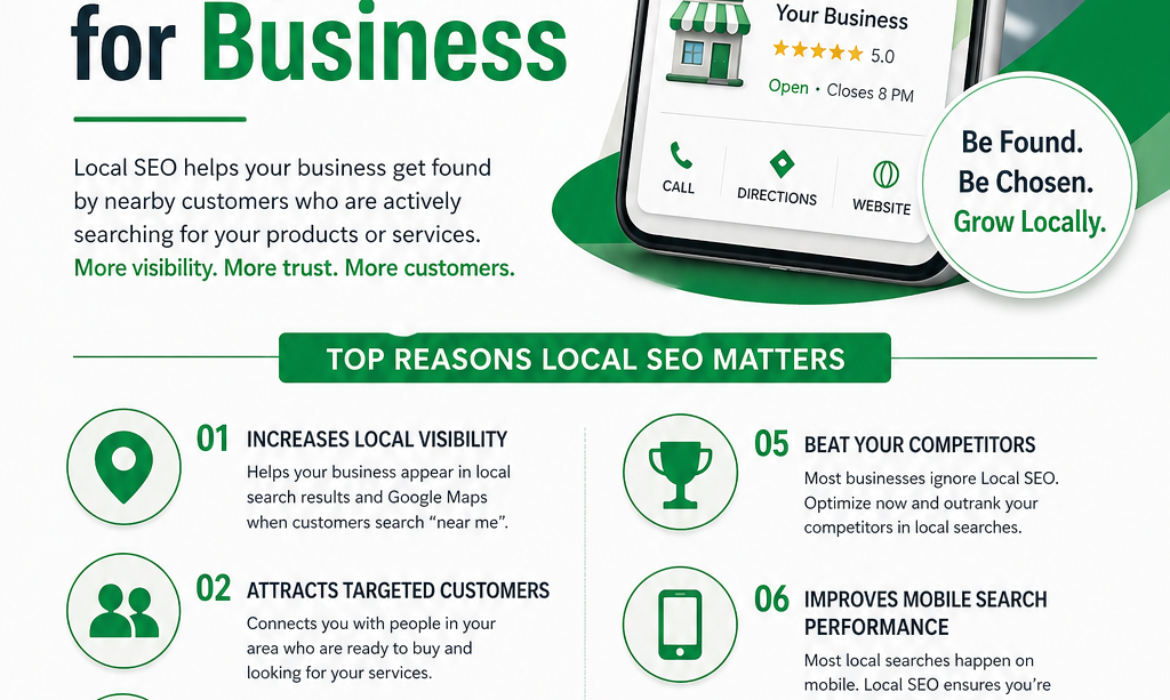
Why Local SEO Is Important for Your Business
In today’s digital world, customers search online before visiting a shop, clinic, restaurant, or service provider. Whether someone is looking for a nearby restaurant, a doctor, a salon, or a repair service, they usually search on Google using phrases like “near me” or “best service in my area.” This is where Local SEO becomes extremely important for businesses.
Local SEO (Search Engine Optimization) is the process of improving your online presence so that your business appears in local search results. It helps businesses connect with nearby customers who are actively searching for products or services. For small and medium businesses, Local SEO is one of the most effective ways to attract real customers and increase sales.
One of the biggest advantages of Local SEO is better visibility on Google Search and Google Maps. When your business profile is properly optimized, your company can appear at the top of local search results. This increases the chances of customers visiting your website, calling your business, or directly visiting your location.
Another important benefit of Local SEO is building trust and credibility. Customers usually prefer businesses with positive reviews, accurate information, and professional online profiles. A well-managed Google Business Profile with updated contact details, photos, business hours, and customer reviews creates confidence among potential customers.
Local SEO also helps businesses target the right audience. Unlike traditional advertising, which reaches a broad audience, Local SEO focuses on people in your nearby area who are already interested in your services. This means higher conversion rates because local customers are more likely to take immediate action.
Mobile searches have also increased rapidly over the last few years. Many users search for local businesses using smartphones while traveling or shopping. If your business is optimized for local searches, customers can easily find directions, contact information, and reviews directly from their mobile devices.
In addition, Local SEO is cost-effective compared to paid advertising. While paid ads stop generating results once the budget ends, Local SEO provides long-term benefits. By regularly updating your business information, creating quality content, and collecting customer reviews, you can continue attracting customers without spending heavily on advertising.
Competition is another major reason why Local SEO is important. Many businesses are already using local optimization strategies to rank higher in search results. Without Local SEO, your competitors may attract customers who could have chosen your business instead.
To improve Local SEO, businesses should optimize their Google Business Profile, use location-based keywords, maintain consistent contact details across websites, encourage customer reviews, and create useful local content. Fast-loading websites and mobile-friendly designs also play an important role.
In conclusion, Local SEO is essential for any business that wants to grow locally and reach more customers. It improves online visibility, builds trust, increases website traffic, and drives more sales. In a competitive digital market, investing in Local SEO is no longer optional — it is a smart and necessary strategy for long-term business success.

SEO in the Age of AI: Why Search Is Evolving Faster Than Ever
SEO is no longer what it used to be—and that’s not a bad thing. With artificial intelligence reshaping how search engines understand, rank, and deliver content, SEO is changing fast with AI at the core of this transformation. Businesses, marketers, and content creators who adapt quickly will stay visible; those who don’t risk being left behind.
Search engines like Google now rely heavily on AI-driven systems to interpret user intent rather than just matching keywords. This means SEO is shifting from keyword stuffing to intent-focused, value-driven content. AI helps search engines understand context, semantics, and even emotions behind search queries, delivering more accurate and personalized results.
Another major shift is the rise of AI-powered content evaluation. Search algorithms can now assess content quality, originality, and usefulness at scale. Thin, generic, or AI-generated content without real value is easier to detect and less likely to rank. As a result, human expertise, experience, and trustworthiness—often referred to as E-E-A-T—have become critical ranking factors.
Voice search, visual search, and conversational queries are also growing rapidly due to AI advancements. Users now search the way they speak, asking full questions instead of typing short phrases. This has pushed SEO toward long-tail keywords, natural language optimization, and structured data to help AI systems better understand content.
AI is also transforming how SEO strategies are built. From predictive keyword research and competitor analysis to content optimization and performance tracking, AI tools are making SEO more data-driven and efficient. However, strategy and creativity still need a human touch—AI supports SEO, but it doesn’t replace smart decision-making.
In short, SEO is evolving from a technical checklist into a holistic, user-first discipline powered by AI. Success in modern SEO depends on creating meaningful content, understanding user intent, and leveraging AI tools wisely. As AI continues to advance, one thing is clear: SEO isn’t dying—it’s getting smarter.
